
The best architecture invites openness — light, air, and visual connection. Yet when it comes to safety barriers, these qualities are often the first to be sacrificed. Heavy glass panels, perforated metal screens, and bulky balustrades have long dominated the landscape, prioritising compliance over experience.
A quiet design revolution is changing that.
Across Australia’s schools, universities, and public buildings, architects are turning to tensile barrier systems — woven from fine stainless-steel cables and mesh — to create barriers that protect without enclosing.
From Solid to Permeable
Traditional barrier materials were conceived to resist — to block or contain. But as projects have become lighter and more connected, the architectural language around safety has evolved too.
Tensile materials like Jakob Webnet mesh behave more like fabric than structure. They drape, wrap, and flow — allowing architects to think in three dimensions rather than being confined to a plane. Their transparency invites natural light and ventilation while maintaining complete fall protection.
At the Melbourne School of Design, a five-storey atrium is enclosed with full-height stainless-steel mesh, providing safety without interrupting the visual link between levels. At Inner Sydney High School, Webnet barriers open the terraces and rooftop courts to the city skyline, proving that safety can feel expansive, not restrictive.
Strength in Simplicity
Behind the apparent delicacy of a tensile barrier lies an impressive strength-to-weight ratio. A single 3mm cable can withstand over 500kg of load, and entire systems can span multiple storeys with minimal framing. That efficiency translates to faster installation, lower embodied carbon, and a cleaner visual language.
Unlike glass, which requires frequent cleaning, or perforated panels that trap debris, stainless-steel mesh barriers are almost maintenance-free. Their lifespan — 25 years or more — far exceeds many traditional alternatives.
Form, Function and Freedom
Perhaps the most compelling reason architects are embracing tensile barriers is freedom.
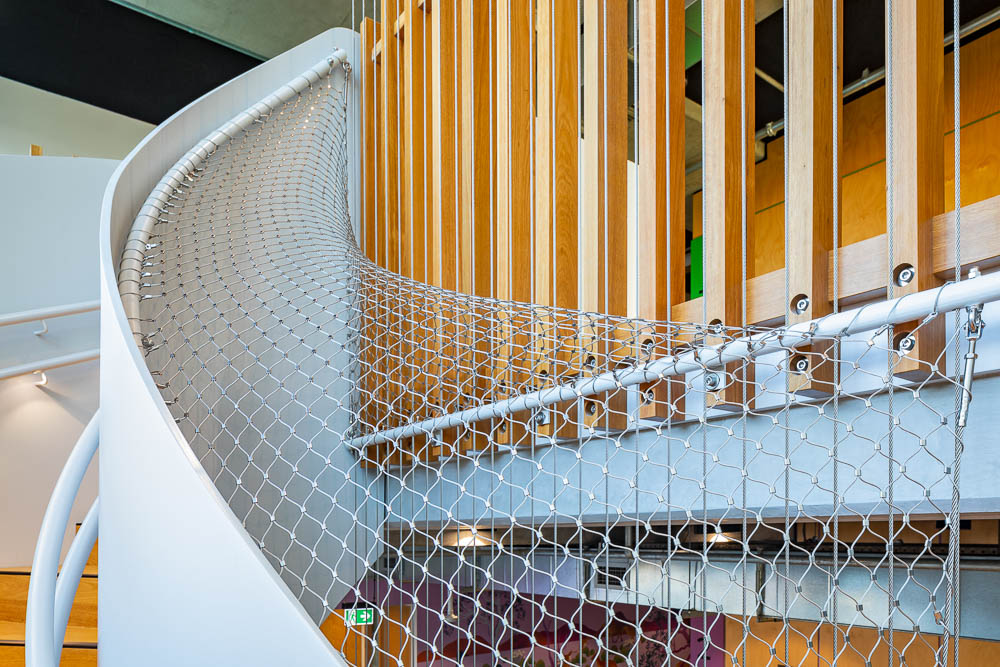
The flexibility of stainless-steel mesh allows it to conform to curved forms and complex geometries. It can spiral around staircases, wrap atriums, or stretch across bridges without breaking rhythm or visual continuity.
At the Royal Far West Children’s Charity in Manly, a corkscrew-shaped Webnet barrier twists through a spiral staircase — a geometry that would have been impossible with conventional materials. The result is both sculptural and safe, transforming a functional element into a focal point.
Designing the Invisible
Good barrier design doesn’t draw attention to itself. It simply allows the architecture to breathe. That’s the paradox of tensile design — strength that disappears into lightness.
As buildings become more vertical, open and dynamic, the way we design for safety is evolving with them. Tensile barriers are proving that protection and beauty don’t have to be at odds — and that sometimes, the best design decision is the one you barely notice.