
I’ve been knee-deep in a project lately that keeps circling back to one nagging question: if green infrastructure like facades, cool roofs, vine-covered car parks, all of it, actually works, why isn’t it everywhere?
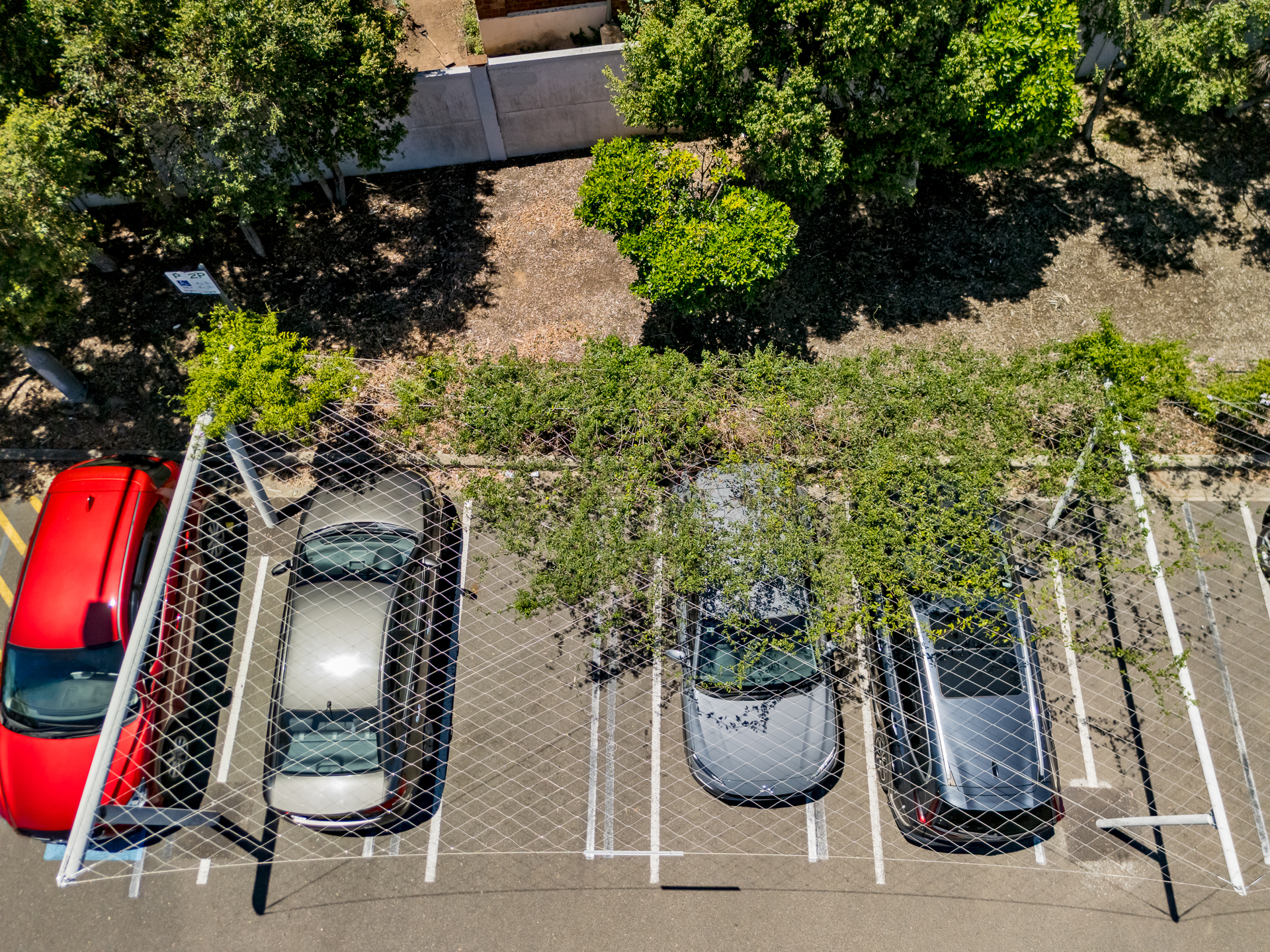
Because it does work. There’s Australian field data now showing car park surfaces cooled by tens of degrees under a vine canopy, UV blocked by 80%+, thermal comfort transformed, and all of it deployable in under two years rather than the twenty-plus it takes for a tree canopy to mature. That’s not a hypothetical. That’s measured.
So why are we still pouring black asphalt and calling it a day?
Is it actually a money problem, or do we just say that?
“There’s no business case” is the line you hear a lot. But I wonder if that’s sometimes a polite way of saying “nobody’s done the maths” rather than “the maths doesn’t work.” Those are very different problems with very different fixes. One needs an economist. The other needs someone willing to run the numbers and be first.
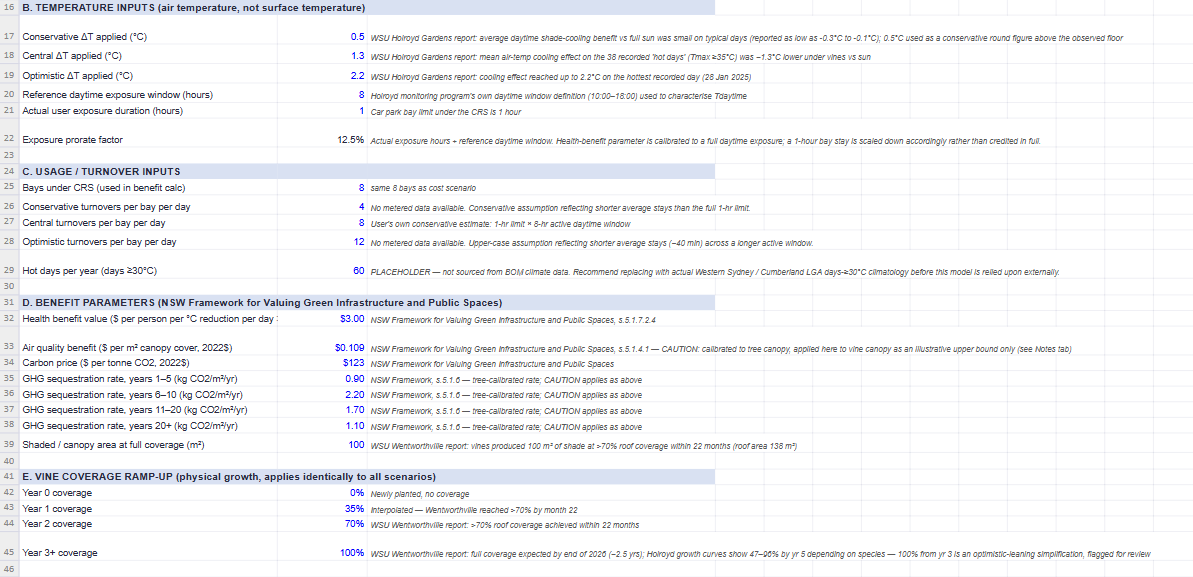
And when you go looking for a framework to actually value this stuff (he health benefits, the cooling, the carbon) you find governments *have* built one. NSW has a whole methodology for putting dollar figures on green infrastructure. Which sounds like the problem’s solved, right?
Except… open it up, and it’s really built around trees and parks and neighbourhood-scale canopy cover. Household by household, hectare by hectare. It was never built with a car park bay or a building facade in mind. So is the tool actually the barrier? Do we force-fit hardscape retrofits into a model designed for something else, and hope nobody looks too closely at the seams? Or is there something more honest we could be doing, perhaps extending the method rather than borrowing it wholesale?
Who actually benefits, and does that matter?
Here’s one that keeps bugging me: a lot of green infrastructure’s value shows up as *health* benefit, someone standing in a car park for an hour is a bit cooler, a bit less stressed, a bit less exposed to UV. But who captures that value? Not the council that paid for the trellis. Not the property owner. It’s diffuse, it’s public, it’s barely felt by any single person, and yet it’s real in aggregate.
Compare that to something like solar panels, where the person who pays is the person who saves on their power bill. Green infrastructure doesn’t have that clean loop. So maybe the uptake problem isn’t really about valuation at all. Maybe it’s a classic split-incentive problem wearing a valuation costume. Who *should* pay for a public cooling benefit? And does the answer change depending on whether we’re talking about a shopping centre car park, a public street, or a school yard?
Are we scared of being the first data point?
Something else worth sitting with: almost none of the cost-benefit thinking around this stuff has real, local, monitored data behind it. Everyone’s assumptions get borrowed from somewhere else, adjusted, caveated, footnoted with “placeholder pending better data.” Which is fine, until you realise *someone* has to be the first project that isn’t built on borrowed assumptions. Someone has to actually measure the thing, publish the number, and let it get picked apart.
Is that what’s really holding this back? Not a lack of enthusiasm, not a lack of technology, but a lack of appetite for being the exposed, scrutinised, first-mover case study that everyone else quietly free-rides off later?
Or is it simpler than all that?
Maybe I’m overthinking the economics of it. Maybe it really is just inertia, asphalt is what we’ve always done, it’s what the standard details specify, it’s what the contractor already knows how to price, and green infrastructure is still filed under “nice to have” rather than “infrastructure.” Sometimes the biggest barrier to change isn’t a bad business case. It’s that nobody’s even been asked to write one.
So genuinely, I’d love to hear what people think:
– Is it a valuation gap, an incentive gap, or a plain old imagination gap?
– Should the public sector be the one taking the risk on being “data point one,” or is that asking too much of already-stretched budgets?
– And if you *did* have a rock-solid, defensible business case sitting in front of a council tomorrow, do you actually think it would change the decision? Or would something else quietly get in the way anyway?
I don’t think there’s one clean answer here. But I suspect the more people who ask the question out loud, the sooner someone builds the case that finally moves the needle.