
Every landowner and architect who has ever specified a car park has run into the same problem: shade is the single most effective thing you can add to reduce urban heat, and trees are the obvious way to deliver it — except trees take fifteen to twenty years to produce meaningful canopy. In the meantime, the asphalt keeps cooking, the surface keeps degrading, and the parking bays you need can’t be sacrificed to plant them.
Two years of data from a research partnership between Tensile Design & Construct, Western Sydney University and Cumberland City Council shows there’s a faster path — one that delivers comparable, and in some cases better, cooling performance without losing a single parking space.
The problem with waiting for trees
Unshaded, at-grade car parks are among the most reliable sources of urban heat in any city. Surface temperatures on bare asphalt regularly exceed 65–70°C on a clear summer day. More than 6 km² of unshaded car park area exists across Western Sydney alone, and that footprint is growing alongside new transport, retail and health infrastructure.
Trees remain the benchmark for urban cooling, but they’re a long-term asset, not a near-term fix. For landowners and architects working to timelines measured in months and years rather than decades, that mismatch has historically left car parks stuck as “despicable places” — necessary, but thermally hostile.
A structure designed to close that gap
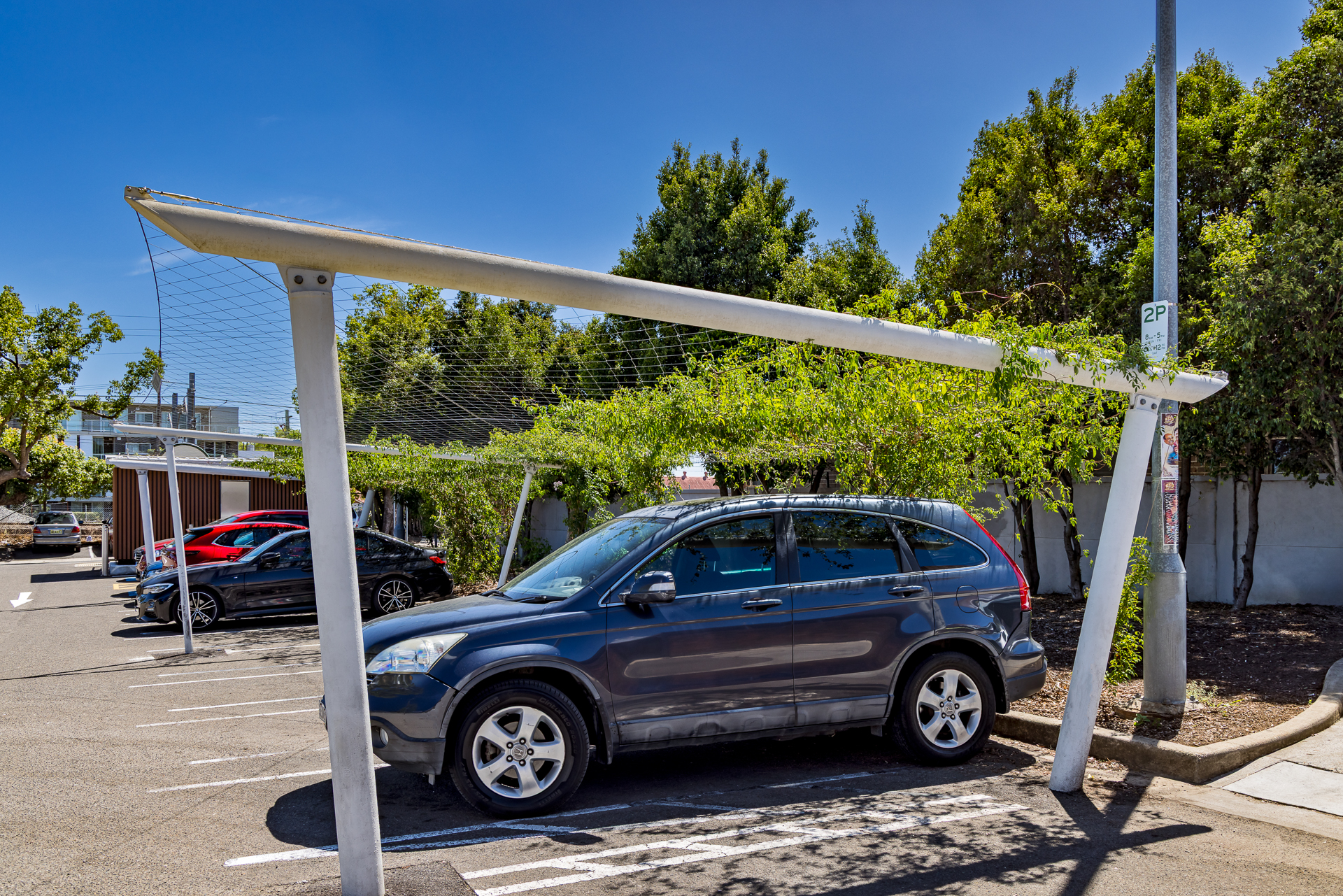
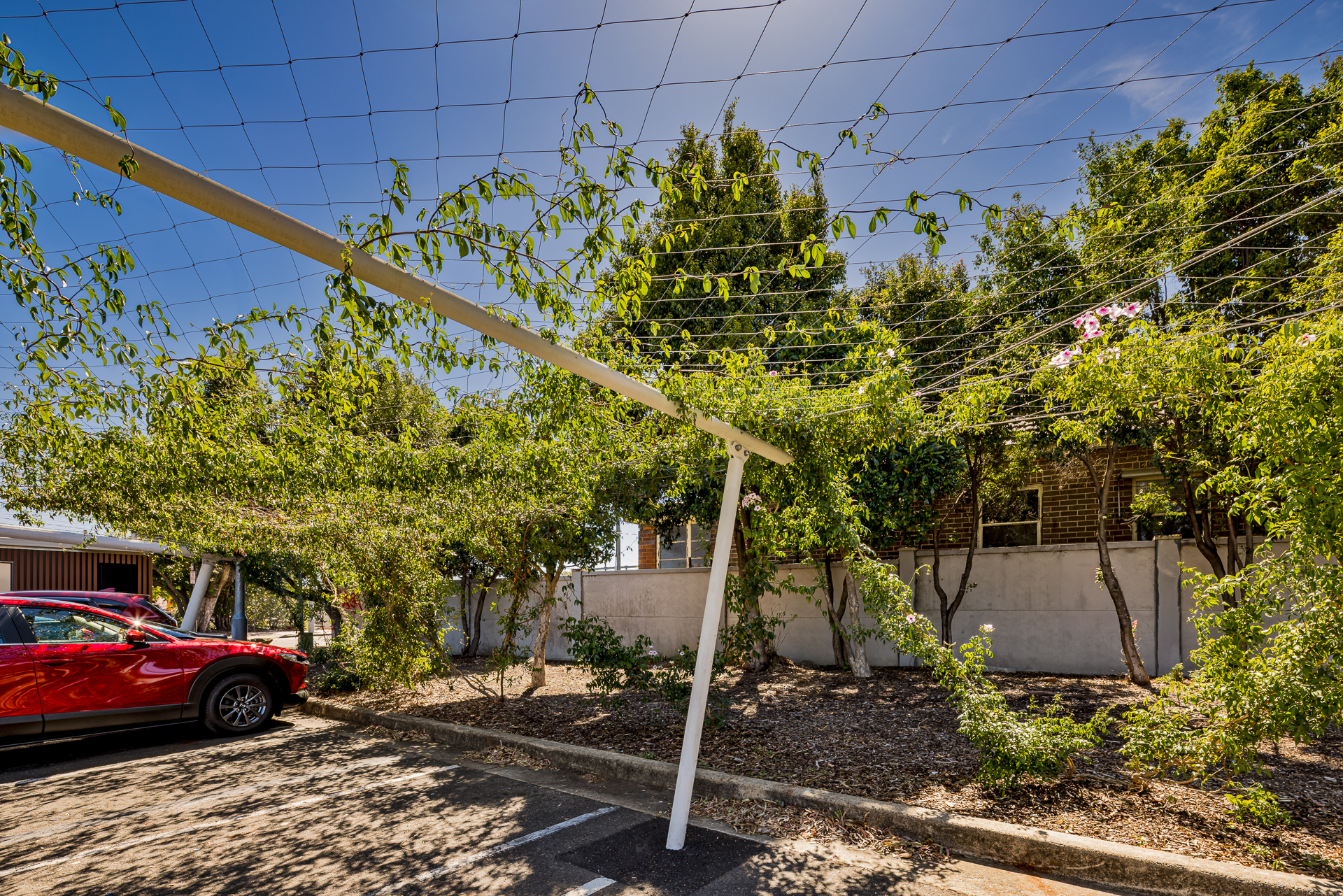
The Cool Roof System (CRS) is a modular, freestanding steel frame that supports a stainless steel Webnet mesh roof over existing parking bays. Fast-growing native vines (Wonga Wonga and Bower vine) are planted at the rear of the structure and trained up guide wires to spread across the mesh, forming a living, green canopy above the cars below.
The first prototype was built at Holroyd Gardens in 2023. A second-generation version, refined based on two years of operational learnings, was installed at the Wentworthville Station commuter car park in 2024. Both sites have now been through a full, independently monitored research program, not a single case study, but a replicated, iterated system.
What the data shows
The results across both sites make a clear case that this isn’t a slower, greener compromise, it’s a genuinely competitive cooling strategy on its own terms:
- Shade in under two years, not two decades. At Wentworthville, the vine canopy covered 71% of the roof structure and produced 100 m² of usable shade within 22 months of planting. The equivalent canopy from a newly planted tree would take upwards of 20 years to establish.
- Cooling performance that matches – and at times exceeds – mature trees. Surface temperature reductions on asphalt averaged 19°C under the vine canopy, with a maximum recorded reduction of 35°C. In side-by-side comparisons at Holroyd Gardens, vine shade outperformed the shade cast by established trees on the same surface, largely because the canopy sits much closer to the ground and produces a more concentrated shadow.
- The hotter it gets, the better it performs. The cooling effect of the vine canopy strengthened as ambient temperatures rose (R² = 0.81 between unshaded and shaded surface temperatures across a 46–65°C range). This is the opposite of what you’d expect from most passive shading strategies, and it means the system delivers its greatest benefit exactly when car park users need it most.
- Meaningful reductions in human thermal comfort. Black globe (“feels-like”) temperatures dropped by up to 10°C under the canopy, and the system blocked an average of 74% of UV radiation and around 60% of near-infrared radiation — the component of sunlight most responsible for heating hard surfaces and vehicle interiors.
- Zero loss of parking capacity. Both structures were engineered around existing bay dimensions. No parking spaces were removed at either site.
Built to scale
Because the CRS uses a standard steel frame, tensioned cable system and Webnet mesh roof, it doesn’t require site-specific engineering to replicate. The same modular components that covered eight bays at Wentworthville can be scaled up for shopping centre car parks, extended along hospital drop-off zones, or installed above train station commuter parking, anywhere shade is needed but tree planting isn’t feasible due to space, services, or timeframes.
The system also works on private land. The same combination of vines, trellis and mesh can be adapted into carports, pergolas, and shade structures for building facades delivering the same cooling and UV-blocking performance with the same fast timeline to full coverage.
The takeaway for architects and landowners
Shade doesn’t have to be a twenty-year commitment anymore. The Cool Roof System offers a validated, data-backed alternative that delivers full cooling performance within two growing seasons, without giving up a single car space, and its benefits get stronger, not weaker, as our summers get hotter.
If you’re planning a car park, a commercial development, or any hardscape that needs shading now rather than in 2045, we’d like to talk.
*Data referenced in this article is drawn from independently monitored research conducted by Western Sydney University in partnership with Tensile Design & Construct and Cumberland City Council, published March 2025 and April 2026.*