
There’s a tendency in infrastructure projects to treat the barrier as an afterthought — a compliance item to be resolved late in the design process, value-engineered down to the cheapest solution that passes the code check. It’s an understandable instinct given the pressures of large-scale delivery. But it’s one that leaves significant value on the table. Not just aesthetic value, but structural and economic value too.
The pedestrian bridge barriers Tensile designed and constructed for the Estelle and Heyington crossings on Melbourne’s North East Link Freeway Upgrade — working alongside Kyriacou Architects — make the case for thinking differently. Together, they show what becomes possible when the barrier is treated as a genuine design element rather than a last-minute line item.
Webnet as a Design Material
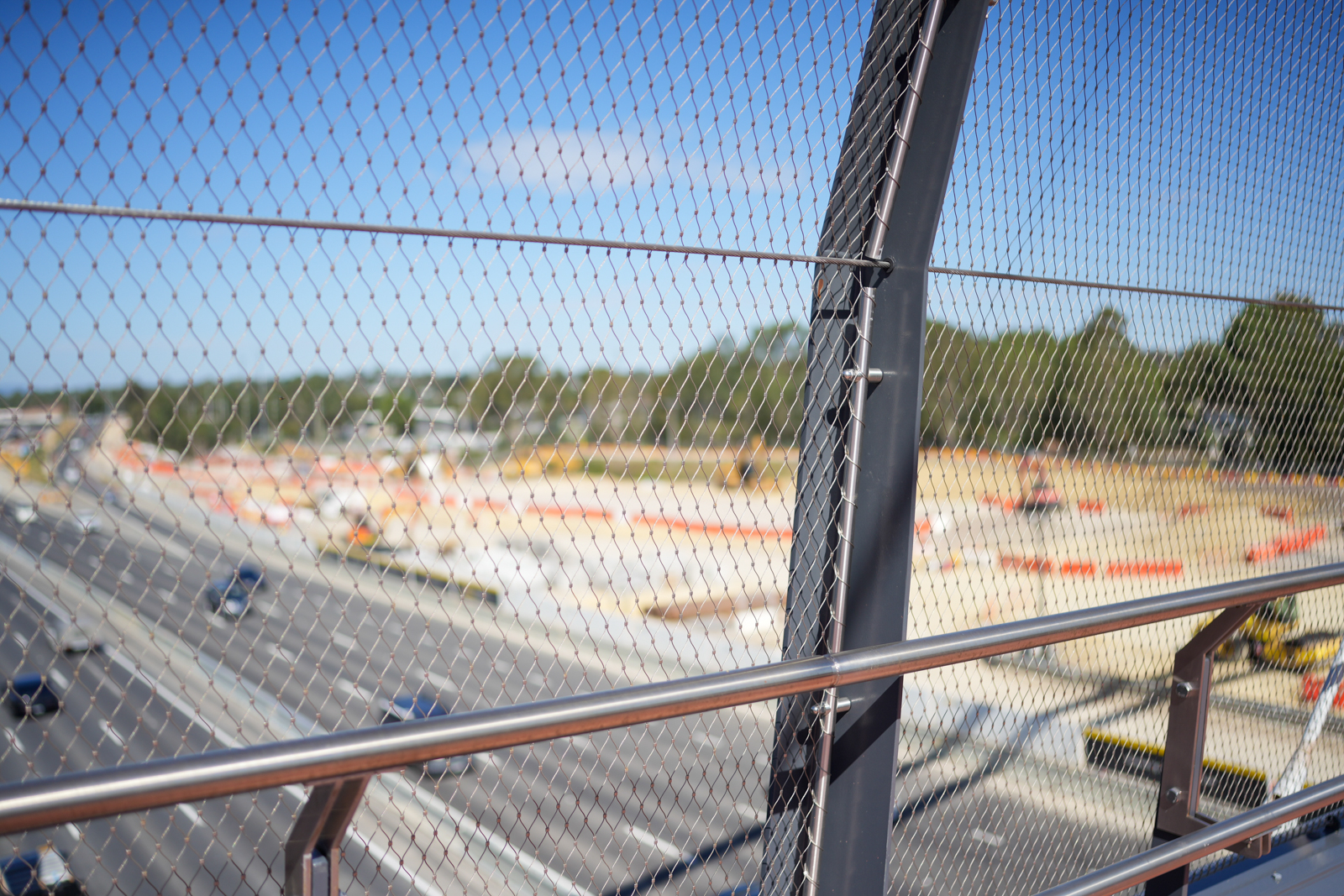
Tensile’s Webnet is a stainless steel wire rope mesh — open, lightweight, and highly adaptable. Specified at 35mm × 1.5mm for both Estelle and Heyington, it performs as a compliant barrier infill while maintaining the visual permeability that closed systems simply cannot offer. Where solid panels or bar-filled frames create walls, Webnet creates edges — defined boundaries that don’t impose on the space or the view beyond.
For architects working on bridges, elevated walkways, and public infrastructure, this distinction matters. A bridge is rarely just a piece of engineering. It’s a civic experience, often set within a landscape. The barrier is the element the pedestrian is most physically close to — the thing they lean on, look through, and move alongside for the entire crossing. Getting it right changes the experience of the bridge entirely.
But Webnet’s value as a design tool goes further than appearance. Because the mesh itself carries the infill load through tension, the structural system supporting it can be resolved in multiple ways — and that flexibility opens up a range of architectural and engineering possibilities that more conventional barrier types don’t allow.
Two Bridges, Two Structural Approaches
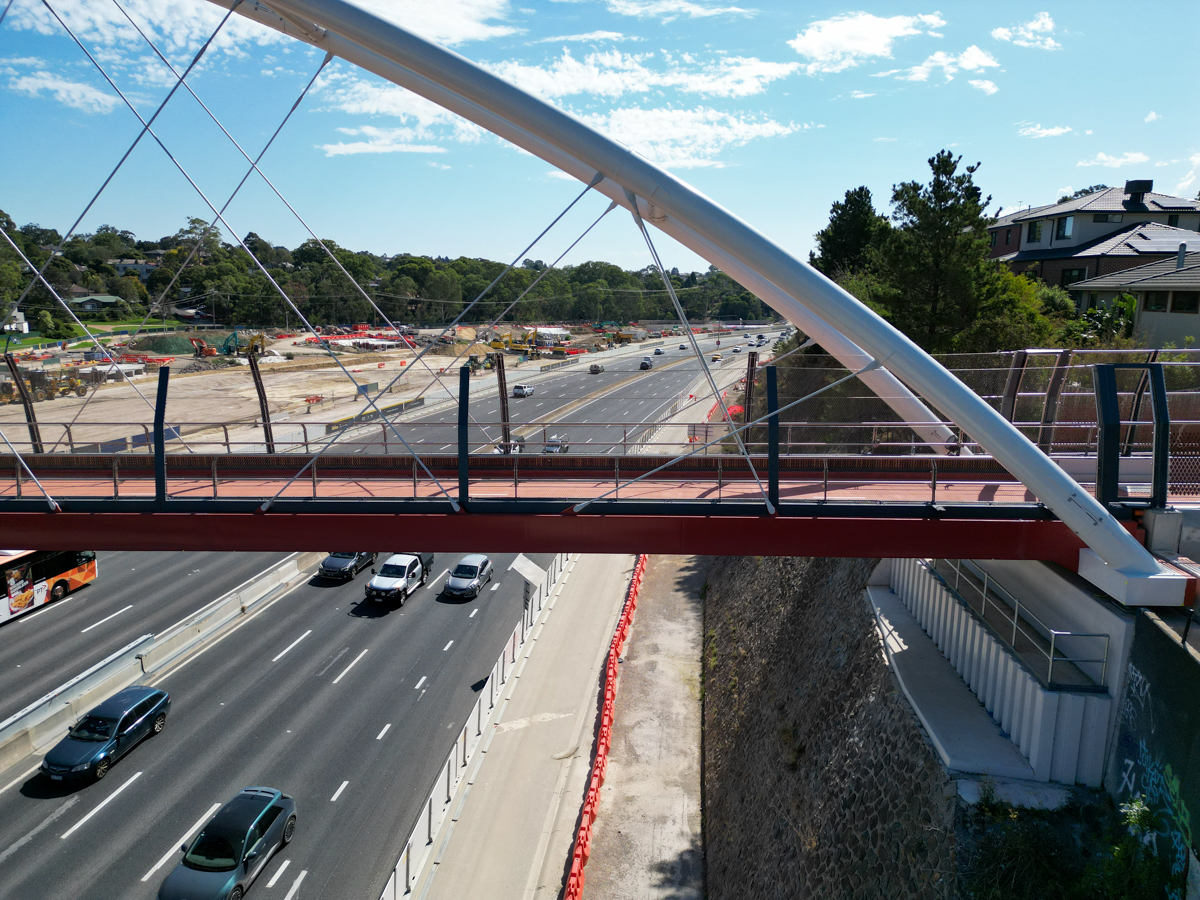
Estelle and Heyington illustrate this flexibility directly. Both use the same Webnet mesh specification. Both were designed in collaboration with Kyriacou Architects as part of the same major infrastructure project. Yet the structural logic behind each barrier is fundamentally different — and the choice of approach in each case was driven by what the project actually needed.
Estelle — Prefabricated Frame System
At Estelle, the Webnet mesh is carried by a series of custom stainless steel tubular frames. The frames have a sculptural quality — they are structural elements, but they’re designed to be seen. Posts sit at 2m centres, giving the barrier a rhythm and a presence that suits the character of the crossing.
The more significant design decision, however, was about how the barrier would be built. Each frame was pre-laced with Webnet in Tensile’s workshop — arriving on site as a complete, finished unit. This meant the barriers could be installed onto the bridge deck before the deck was craned into its final position, rather than requiring working at height on a live construction site.
For architects, this is worth understanding: prefabrication is not just a construction efficiency measure. It’s a quality control strategy. Work done in a controlled workshop environment — with the time and access to get every detail right — consistently produces a better result than work done on site under programme pressure. The Estelle barriers arrived on site exactly as designed. There was no compromise in the field.
Heyington — Long-Span Cable System
Heyington is where the design thinking becomes particularly compelling. Rather than frames, the Webnet mesh is supported by a system of perimeter stainless steel cables — and this shift in structural logic allows posts to be spaced at 6m centres rather than 2m. Three times the spacing of Estelle.
That single change has consequences that ripple well beyond the barrier itself.
The visual effect is transformative. With two-thirds of the posts removed, the barrier becomes almost immaterial. The Webnet mesh reads as a suspended plane — a defined edge with almost nothing behind it. Sightlines are largely uninterrupted. The boundary between pedestrian and structure dissolves. This is the kind of lightness that architects work hard to achieve in their buildings, and it’s rarely seen in infrastructure at this scale.
The structural implications are substantial. Dead load on a bridge is not an abstract engineering concern — it determines the size of the deck, the beams, the connections, and the foundations. Every kilogram removed from a bridge barrier reduces the structural demand across the entire system. Reducing post frequency from 2m to 6m centres removes a significant amount of steel from the structure, and that reduction cascades downward through every element the barrier load touches.
The economic case follows directly. Less material in the barrier means less material in the bridge. The savings that flow from a lighter, more efficiently detailed barrier system are felt not just within Tensile’s scope, but across the project as a whole. The Heyington barrier demonstrates something that’s easy to state but harder to actually deliver: that a better-designed component can cost less, not more.
What This Means for Architects
The lesson from Estelle and Heyington isn’t that one approach is superior to the other. Both were the right solution for their respective contexts. The lesson is that the barrier system deserves to be part of the design conversation early — not resolved after the structure is fixed and the budget is committed.
When Webnet mesh is considered as a design tool from the outset, it gives architects genuine choices. Choices about visual weight and permeability. Choices about how the barrier relates to the broader structure. Choices about prefabrication strategy and programme efficiency. And choices that can, as Heyington demonstrates, improve the performance and economy of the entire bridge — not just the barrier itself.
Infrastructure projects are complex, fast-moving, and rarely forgiving of late design changes. But they are also, increasingly, held to a higher standard of design quality. The public expects bridges that are well-considered, not just structurally adequate. Kyriacou Architects understood this on North East Link, and the result is a pair of crossings that demonstrate what’s possible when architecture and engineering work together from the beginning.
Tensile works with architects at the early stages of projects specifically because that’s where the most value is created. If you’re working on a bridge, elevated walkway, or public infrastructure project and want to understand what Webnet mesh can offer — structurally, aesthetically, and economically — we’d welcome the conversation.