
Trees are the first solution suggested when projects need shade, cooling or greenery. And where they’re possible, they’re hard to beat.
But many urban sites don’t allow for trees at all.
Basements, podium slabs, services, tight footprints and the need to keep spaces fully usable all limit where trees can go. Car parks, campuses and public spaces often need shade and cooling now, not decades into the future.
When trees aren’t an option, architects are increasingly turning to vines supported by lightweight tensile structures — a practical way to add greenery, shade and cooling without giving up space.
Urban constraints are the norm, not the exception and across education, civic and public-realm projects, the same constraints come up again and again:
-
Shallow soil depths over structure
-
Underground services and overhead limitations
-
High-use areas where space can’t be lost
-
Sites that need immediate performance
-
Long-term durability with minimal maintenance
The ambition to green these spaces is there. The challenge is finding solutions that actually work within these limits.
Vertical Greening Where Trees Can’t Go
Climbing plants supported on stainless-steel mesh or cable systems offer a fundamentally different approach. Vines and climbers require far less soil volume, can grow from planters either mounted to the facade or located on the surface and will establish quickly.
The shade can be guided to the exact location where it is needed most. In a recent project Tensile was able to establish shade equivalent to a 50 year old eucalypt in under two years. This makes vines well suited to tight, built-up sites. The Laneway project for the University of Melbourne is a great example of this where a simple solution has introduced a large volume of planting into a tight heritage precinct without disruption to the function or circulation.
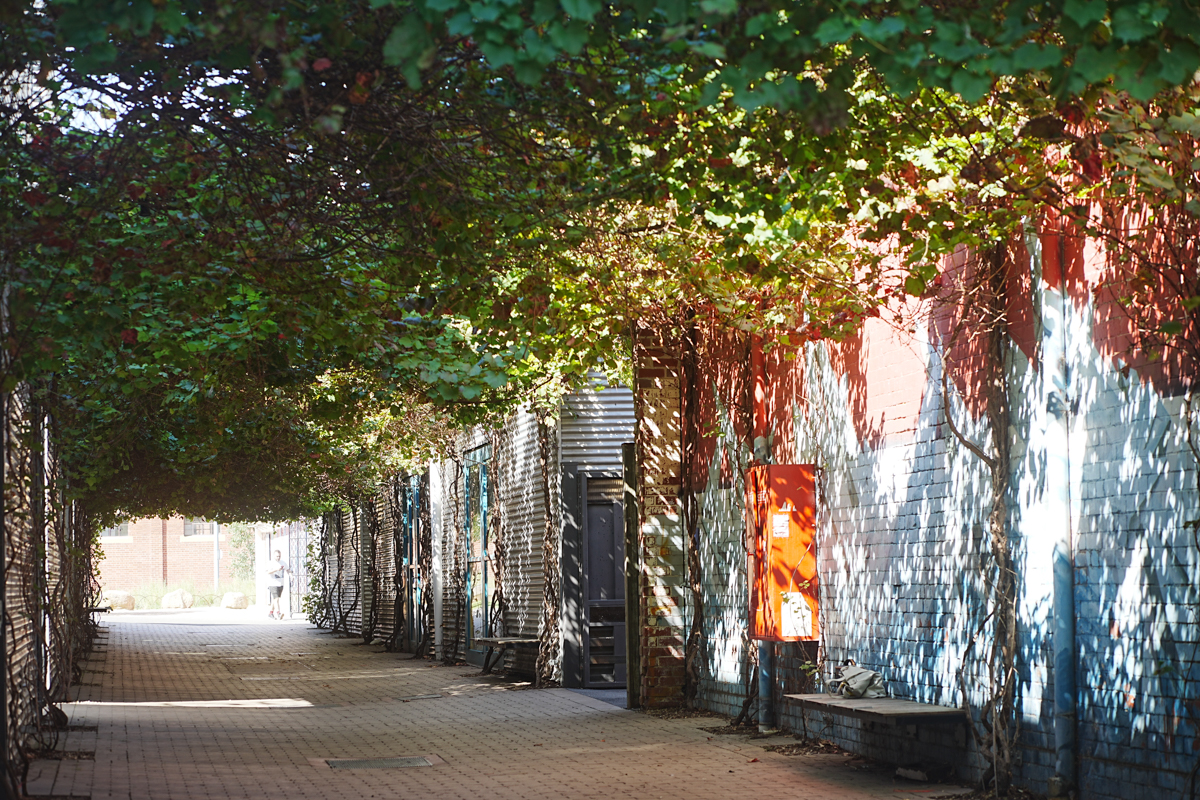
Hard surfaces like concrete and asphalt are major contributors to urban heat. Shading these areas is one of the most effective ways to reduce heat build-up and improve comfort. The shade has an immediate impact reducing surface temperatures by greater than 50% compared with those unshaded. Views remain unblocked, sunlight can still permeate the space and airflow is maintained. Further the evapotranspiration from the vines can provide a cooling effect to the surrounding air of 1.5-2 degrees. The greater the area of coverage the greater the impact of this. All of this makes vine canopies ideally suited to elevated or hard-landscaped public zones.
At Skypark, Melbourne Quarter, cable and mesh systems support planting across elevated public areas, helping soften and cool a dense mixed-use environment without adding visual bulk or structural weight.
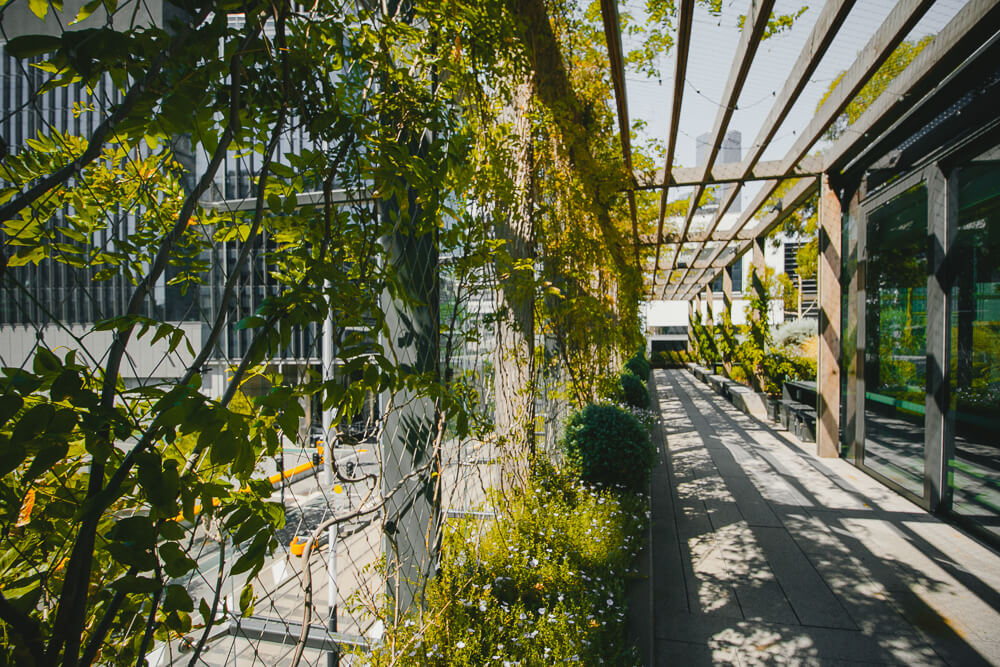
A Scalable, Low-Impact Approach
Another strength of tensile-supported vine systems is their adaptability. At Tensile we can retrofit these to existing buildings, being generally modular in nature they are easily scalable from small courtyards to large public spaces. Tensile’s team is able to take care of the engineering for various loading and/or wind conditions and we are provide the solution in durable, low maintenance materials. Stainless-steel mesh and cable systems offer long service life, making them well suited to public and institutional environments.
Vines don’t replace trees — they fill the gaps where trees can’t go. As cities get hotter and sites become more constrained, lightweight structures and climbing plants are proving to be a practical, effective way to introduce shade, greenery and cooling where it’s needed most. Sometimes the best solutions aren’t the biggest ones — they’re the ones that fit.