
Stainless steel cable tensioning systems often appear simple and effortless, but a huge amount of precision engineering goes on behind the scenes!
Let’s take a look at what’s involved in different types of projects that rely on cable tensioning systems.
Webnet barriers
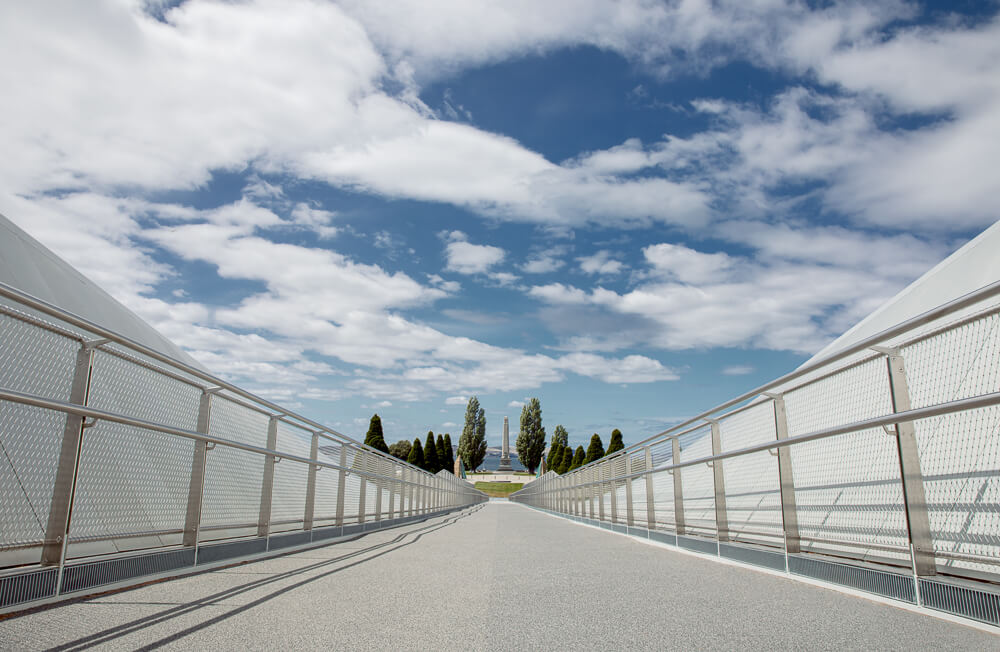
The Tensile team has designed and installed many Webnet mesh barriers over the years.
Barriers made from Webnet are transparent and very light in appearance. But these structures have to meet strict safety compliance for the most extreme loads applicable to the structure.
Pedestrian and cyclist bridge barriers for example must be fully compliant with bridge code AS5100, and in the process address forces from crowds, wind, panic and even earthquakes.
As such, they must meet the following requirements:
- Pedestrian and cyclist path barrier loads (similar to AS1170 C3).
- Panic loads (similar to AS1170 C5).
- Protection screens loads (such as anti-throw screens, where applicable).
- Climb mitigation – achieved through prevention of footholds.
- Resistance to fire, UV, sea-spray (where relevant), and harsh weather conditions.
Webnet is made from grade 316 stainless steel. The material also has a large span capacity (up to 6,000mm between posts), a very high strength-to-weight ratio (e.g. 520kg B.L. for a single 3mm wire), very low maintenance requirements and high sustainability.
But even the best material requires engineering expertise at installation. Every bridge barrier we install is customised for the structure’s requirements in terms of tensioning, mesh and wire sizes, span and appearance.
To see some examples check out this amazing bridge project in Sydney, and this footbridge in Hobart!
Vertical cable barriers
Stainless steel cables can also be used for safety barriers, such as on indoor atriums.
An example is the vertical cable barrier at the Learning and Teaching Building at Monash University in Melbourne.
In this project we designed a safety barrier that extends over all levels of the atrium space. We used 5mm stainless steel cables to create the barrier, which is non-climbable and fully load-rated. And much like the engineering involved, the barrier’s fixtures and fittings are hidden from view.
Green infrastructure
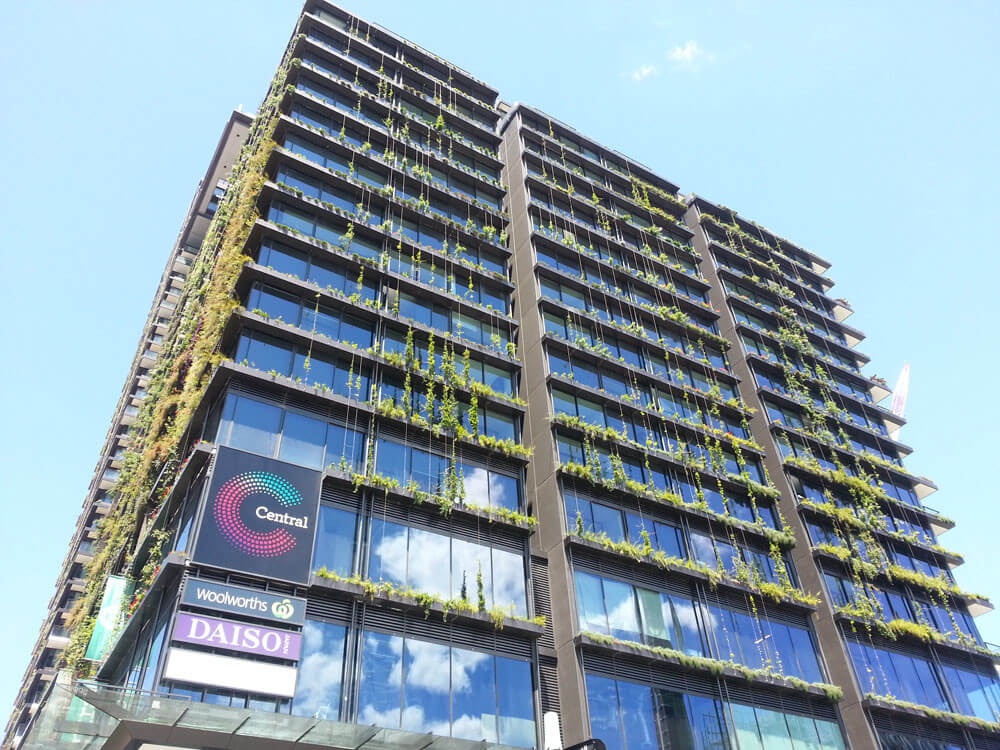
Green facades and walls must be able to resist some pretty strong forces – everything from wind and wild weather to the weight of climbing plants.
Cabling systems must therefore be tightly engineered for these projects. In such cases, we allow for dead weight of plantings at 8kg/m2, with 80% porosity for the plants.
A notable facade project we undertook was the one at One Central Park in Sydney. This was a 34-storey installation that required extensive engineering and modelling beforehand to ensure it could withstand some very high winds.
Another green infrastructure project is the retrofit overhead plant trellis at Melbourne University, which is more of a pergola-type structure than a facade. In this project, we had to use some very detailed engineering work to ensure impacts to heritage and other older buildings were minimised.
Again, with these installations all the design and engineering work that went into them is largely hidden from view – especially once the planters are fully grown!
Hanging gardens
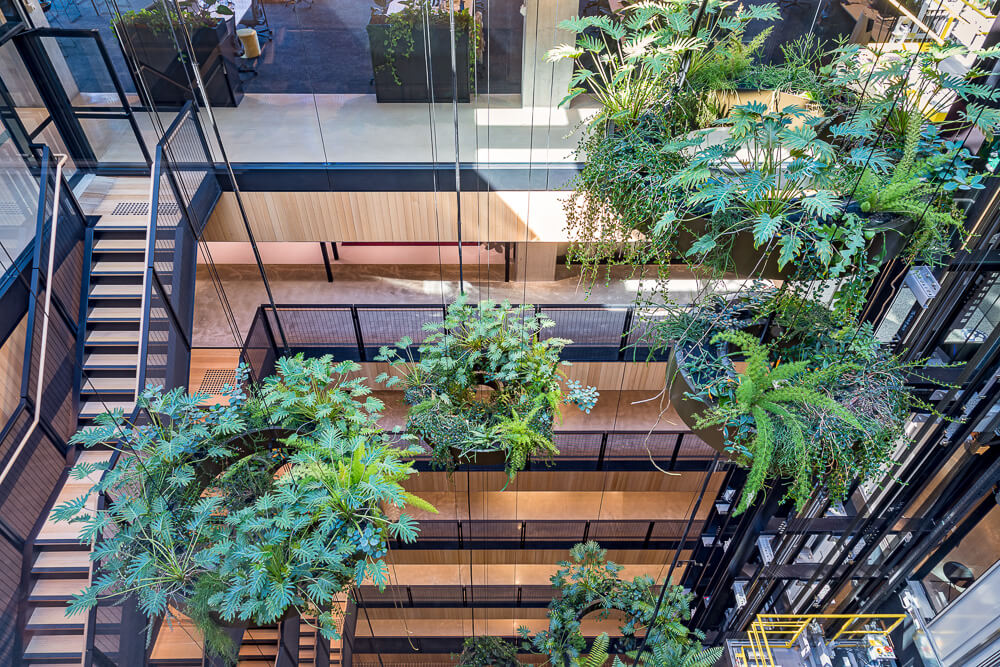
We’ve had some unique projects in our time but the hanging plant display at The Workshop in Sydney is truly one out of the ordinary.
The challenge was to use cables to hang three extremely heavy objects from above within a glass atrium, while ensuring the plants themselves could survive and thrive.
So, we came up with a unique solution – a transfer frame that would distribute the weight, keep the planters steady, and prevent tilt.
The finished result looks pretty amazing. Have a look!
Call us about cable tensioning systems
You can see more examples of cable tensioning systems on our project page. If you’d like to discuss your project, get in touch.